


Storage systems for residential photovoltaic installations: how they work and when they are truly cost-effective
Installing a photovoltaic system allows you to produce electricity using a renewable source and reduce the amount of energy purchased from the grid. However, production and domestic consumption do not always occur at the same time.
The panels produce mainly during the central hours of the day, while many homes concentrate a significant portion of consumption in the early morning, evening, or during the night. It is precisely this time difference that makes a storage system interesting.
The battery allows you to store a portion of the energy produced and not immediately used, making it available when the photovoltaic system produces little or does not produce at all.
But a storage system is not automatically cost-effective for every home. Capacity, power, usage methods, and proper integration with the system must be evaluated based on the family’s actual consumption.
What is a storage system
The storage system is the set of batteries, electronic devices, and control logic used to absorb, store, and subsequently release electrical energy. The Energy Services Manager defines it as a set of devices and management systems capable of modifying the withdrawal and injection profiles of the system with respect to the electrical grid.
It is important to clarify one point: the battery does not produce energy.
Its function is to shift the use of energy already produced by the photovoltaic system over time. In other words, it allows you to use in the evening a portion of the solar energy generated during the day.
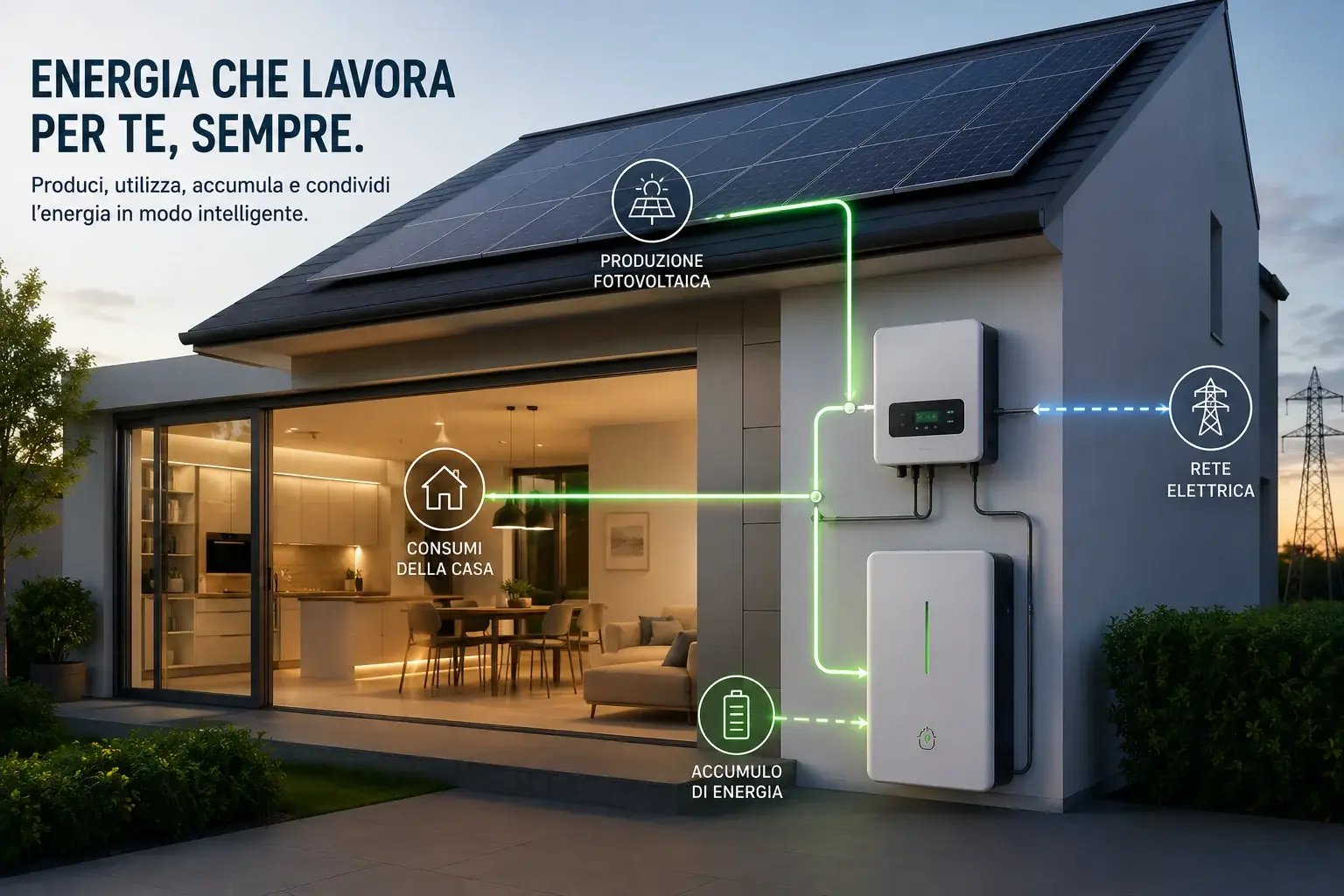
In a system without storage, the energy produced generally follows this path:
- it immediately powers the appliances turned on in the home;
- any excess production is fed into the electrical grid;
- when production is not sufficient, the home draws energy from the grid.
With a battery, part of the excess energy is instead used to recharge the storage system. When the photovoltaic system can no longer cover consumption, the system can draw energy from the battery before resorting to the grid.
Storage and self-consumption: what is the difference?
Self-consumption is the share of energy produced by the photovoltaic system and used directly within the home. According to the GSE, increasing self-consumption allows you to reduce the costs of the variable components of the bill, because it decreases the amount of energy drawn from the grid.
Energy used while it is being produced represents direct self-consumption.
Energy first stored in the battery and used later represents deferred self-consumption.
A storage system can therefore increase overall self-consumption, but does not necessarily make a home independent from the grid. In the winter months, during several consecutive days of bad weather, or in the presence of high consumption, drawing from the grid may continue to be necessary.
For this reason, it is more correct to speak of increased energy autonomy, not complete self-sufficiency.
When a storage system can be useful
The battery is particularly interesting when there is a significant amount of energy produced during the day but not used immediately.
It can be a good solution, for example, for a family that:
- spends a good part of the day away from home;
- concentrates consumption in the evening hours;
- uses heat pumps, air conditioners, or electric heating systems;
- owns or plans to purchase an electric car;
- wants to increase the share of solar energy used directly;
- has a system that frequently feeds energy into the grid.
Conversely, if the home already consumes most of the energy during production hours, the additional benefit of the battery could be more limited.
A typical case is that of a home occupied during the day, in which appliances, air conditioning, and other loads are used mainly while the photovoltaic system is producing. In this situation, the system could already achieve a good level of direct self-consumption without the need for a very large storage system.
Bigger does not necessarily mean better
One of the most common mistakes is thinking that a larger battery always guarantees greater savings.
In reality, an oversized storage system can frequently remain partially discharged or fail to complete a daily cycle. In this case, you sustain a greater investment without fully exploiting the installed capacity.
Similarly, a battery that is too small could fill up quickly and fail to store all the available energy.
Proper sizing should therefore not depend solely on the nominal power of the panels, but on the combined analysis of:
- expected system production;
- annual home consumption;
- hourly distribution of consumption;
- energy typically fed into the grid;
- evening and nighttime consumption;
- presence of significant electrical loads;
- battery charge and discharge power;
- economic objectives and desired level of autonomy.
Two homes with the same photovoltaic system may need very different batteries. A family that consumes mainly during the day has different needs compared to a family that uses most of the energy after sunset.
For this reason, relying exclusively on annual consumption reported on the bill is not sufficient. The most useful data is the consumption profile, that is, understanding not only how much energy is used, but also at what times of the day.
Capacity and power: two values not to be confused
When comparing different storage systems, it is necessary to distinguish between capacity and power.
Battery capacity
Capacity is expressed in kilowatt-hours, indicated by the abbreviation kWh, and represents the amount of energy the battery can store.
A 10 kWh battery, in simplified terms, can store more energy than a 5 kWh battery.
However, it is necessary to verify whether the value indicated by the manufacturer represents the nominal capacity or the actually usable capacity. A portion of the energy may in fact be maintained as a reserve to protect the cells and limit their deterioration.
Charge and discharge power
Power is expressed in kilowatts, that is kW, and indicates the speed at which the battery can receive or supply energy.
A battery can have a high capacity but limited discharge power. In this case, it could power moderate loads for a long time, but not be able to simultaneously support particularly energy-intensive appliances.
Capacity and power must therefore be evaluated together.
A simple way to understand the difference is to think of a water tank:
- capacity indicates how much water it can hold;
- power indicates how quickly water can enter or exit.
Nominal capacity, usable capacity, and depth of discharge
Another important parameter is the depth of discharge, often indicated by the acronym DoD, from the English “Depth of Discharge”.
The battery is not necessarily discharged to actual zero. The management system normally maintains a minimum energy threshold to protect the cells and extend their lifespan.
For this reason, when comparing two products, it is preferable to verify the declared usable capacity and not only the nominal capacity.
The battery management electronic system, called BMS, also plays a fundamental role. It controls voltage, temperature, state of charge, and cell operation, intervening to maintain the system within safe operating conditions.
Efficiency: a portion of energy is lost
The energy that enters the battery is not returned in full.
During the conversion, charge, and discharge phases, losses inevitably occur. To evaluate this aspect, the overall efficiency of the charge and discharge cycle is used, often defined as round-trip efficiency.
An efficient system returns a high share of the stored energy, but no battery is without losses.
This element must be considered when analyzing cost-effectiveness: storage increases the possibility of using solar energy, but direct self-consumption, when possible, generally remains the most efficient method.
Before installing a larger battery, it may therefore be useful to also evaluate simple load management strategies, such as scheduling washing machine, dishwasher, air conditioning, or hot water production during the hours of greatest photovoltaic production.
Lifespan and warranty: what to check
The useful life of a battery depends on numerous factors:
- technology used;
- number and depth of cycles;
- operating temperatures;
- installation methods;
- required power;
- management system;
- environmental conditions.
The warranty should not be evaluated solely based on the number of years. Some manufacturers also provide limits relating to cycles performed, the total amount of energy passed through the battery, or the residual capacity guaranteed at the end of the period.
Before purchase, it is therefore advisable to verify:
- warranty duration;
- guaranteed residual capacity;
- any maximum limit of energy delivered;
- conditions that may result in exclusion from the warranty;
- availability of technical assistance;
- possibility of replacing or expanding modules;
- timing and methods of intervention in case of failure.
A storage system should not be chosen solely based on the initial price. Manufacturer reliability, assistance, and compatibility with other system components can significantly affect the value of the investment over time.
Does the battery work during a blackout?
Not necessarily.
A photovoltaic system with storage connected to the grid can automatically shut down during a power outage, even when the battery is charged. This behavior serves to prevent the system from continuing to power a grid that should be without voltage, protecting operators engaged in interventions.
To use the battery during a blackout, it is necessary for the system to have a specific backup function, often indicated as EPS or emergency power supply.
Depending on the configuration, the backup can power:
- only selected circuits;
- a portion of the home;
- the entire domestic system, within the expected power limits.
Those who consider power continuity a priority must therefore explicitly request this functionality and verify which utilities can be used in the absence of the grid.
The presence of a battery, alone, does not guarantee the operation of the home during a blackout.
Installation on a new or existing system
The storage system can be planned during the design of a new system or added later to an existing photovoltaic system.
In the first case, it is possible to design panels, inverter, battery, and management system from the beginning as a coordinated whole.
In the second case, the following must be verified:
- compatibility with the existing inverter;
- electrical configuration of the system;
- available space;
- manufacturer’s technical requirements;
- any modifications to measurement systems;
- requirements for connection;
- presence of incentive mechanisms already active.
The GSE provides specific configurations for the integration of storage systems and, for systems affected by its mechanisms, dedicated communication procedures. The systems must also be installed in compliance with the permitted technical configurations.
In particular, adding storage to an old incentivized system requires careful preliminary evaluation. It is not advisable to proceed as if it were simply installing a new appliance.
Lithium technology and safety
Most modern residential systems use lithium-ion batteries. Within this category, there are different chemistries, including lithium-iron-phosphate batteries, often indicated by the abbreviation LFP.
Technology is only one of the elements to evaluate. Safety also depends on the quality of the cells, the BMS, the inverter, electrical protections, design, and the conditions of the installation location.
The battery must be placed in an environment compatible with the manufacturer’s instructions, avoiding excessive temperatures, humidity, direct exposure to atmospheric agents, or unsuitable spaces.
A quality product installed poorly can work in worse conditions than a properly designed and sized system. For this reason, installation must be entrusted to qualified personnel and accompanied by the required technical documentation.
How to determine if the investment is cost-effective
The cost-effectiveness of a storage system cannot be established through an answer valid for everyone.
To make a realistic evaluation, it is necessary to compare:
- total system cost;
- energy that can actually be stored each year;
- energy that the family will be able to use;
- expected reduction in grid withdrawals;
- system losses;
- battery lifespan and warranty;
- any maintenance or replacement costs;
- economic value of energy no longer purchased;
- value of energy that, without a battery, would have been fed into the grid.
The simple fact that the system produces excess energy is not enough. It is necessary to verify how much of this energy can be charged into the battery and subsequently consumed.
A reliable simulation must use real or realistic data and consider seasonal trends. A battery that works intensively in spring and summer could be used much less during winter, when photovoltaic production is lower.
Questions to ask before purchase
Before choosing a storage system, it is useful to ask the designer:
- How much energy am I currently feeding into the grid?
- What are my evening and nighttime consumption levels?
- What is the actually usable capacity of the battery?
- What is its maximum charge and discharge power?
- What percentage of the stored energy will I be able to use?
- Is the battery compatible with my inverter?
- Can the system operate during a blackout?
- Which circuits will be powered in emergency mode?
- What does the warranty actually cover?
- What is the estimated payback period and on what data was it calculated?
A professional proposal should provide verifiable answers to these questions, avoiding generic promises of energy independence or savings percentages not supported by consumption analysis.
Conclusions: storage is a design choice
A storage system can make a photovoltaic system more flexible, increase self-consumption, and reduce dependence on the grid during hours when the panels are not producing.
However, it is not a component to be chosen solely based on declared capacity or the most economically convenient offer.
The result depends primarily on the quality of the design: consumption analysis, proper sizing, compatibility between components, installation methods, and intelligent energy management.
The correct question is therefore not only “how many kWh should the battery have?”, but:
how much energy does the system produce, when is it consumed, and what portion can actually be shifted from daytime to evening hours?
It is from this analysis that a truly useful, sustainable storage system emerges, consistent with the needs of the home.
Evaluate the most suitable system for your home
Every home has different consumption, habits, and characteristics. Tops Energy analyzes the energy profile of the home and designs photovoltaic systems with storage systems sized based on the user’s actual needs.
Contact us to request a personalized evaluation.